Basement & Foundation Waterproofing in Durbanville & Northern Suburbs
Vetted Durbanville specialists for below-grade waterproofing — cementitious tanking, crystalline integral systems, bentonite membranes and french drains for slope-side homes.
Benefits
Negative-side AND positive-side options — interior tanking when excavation is impossible
Crystalline systems (Penetron, Xypex, Krystol) that self-seal cracks up to 0.4mm
French drain installation to relieve hydrostatic pressure on slope-side homes
Free moisture-meter survey + hydrostatic-pressure assessment
10-year workmanship guarantee plus manufacturer warranty (15-25 years on crystalline)
Engineer-signed certification for retaining walls and structural basements
Our Process
Free on-site survey — moisture mapping, salt analysis, slope and drainage assessment
Diagnose water source — groundwater, lateral seepage, broken stormwater or rising damp
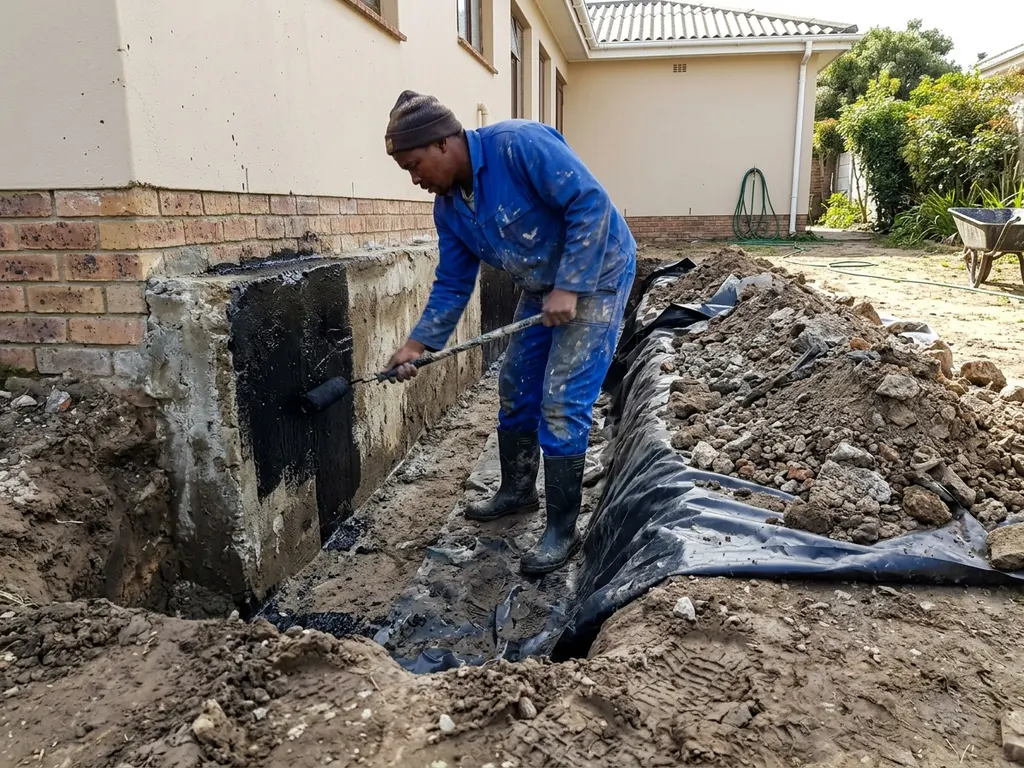
Specify correct system — exterior bentonite/membrane (excavation), interior cementitious tanking (negative-side), or crystalline (new pour)
Excavate exterior down to footing OR hack interior plaster to substrate (system-dependent)
Apply membrane / tanking slurry / crystalline coating per manufacturer spec
Install french drain with geotextile-wrapped stone bed and perforated pipe where hydrostatic pressure is identified
Backfill, reinstate landscaping or re-plaster interior, issue 10-year guarantee + engineer cert
Pricing
From R380/m²
2026 indicative ZAR pricing. Cementitious tanking R380-R650/m², crystalline integral R450-R800/m², bentonite membrane R550-R950/m². French drains R450-R900 per linear metre installed. Excavation, shoring and engineer fees quoted separately on slope-side jobs.
Get Accurate QuoteFrequently Asked Questions
Negative-side vs positive-side waterproofing — what's the difference?
Positive-side means waterproofing the exterior face that water hits first — bentonite or torch-on membrane applied during construction or after excavation. It's the gold standard but needs you to dig down to the footing. Negative-side means waterproofing the interior face from inside the basement — cementitious tanking slurry or crystalline coatings. It's used when excavation is impossible (existing house, neighbour's wall, expensive landscaping). Negative-side has to fight hydrostatic pressure pushing the coating off the wall, so spec and prep are critical.
Do I need to dig up the outside of my house?
Not always. For most existing Durbanville homes with damp basements or garden-level rooms, interior cementitious tanking plus a french drain to relieve pressure is the practical solution — no landscaping destroyed, no neighbour-boundary issues. Exterior excavation is reserved for new builds, structural basement conversions, or cases where the wall is actively failing. The free survey identifies which approach fits your property and budget.
Can damp basements be fixed without excavation?
Yes — interior negative-side tanking systems (Sika 1, Krystol T1, Drizoro Maxseal) bonded to a properly prepared substrate handle most residential damp basements. Pair the tanking with a french drain on the upslope side to relieve hydrostatic pressure and the result lasts 15-20 years. The non-negotiable is substrate prep: hack off all loose plaster, scratch-coat with a bonding slurry, and apply 2-3 coats per manufacturer spec.
What's a french drain and when do I need one?
A french drain is a perforated pipe sitting in a geotextile-wrapped stone bed, installed along the upslope side of a wall or footing to intercept groundwater and channel it away to a stormwater outlet or soak-away. You need one when your home sits on a slope (most of Welgemoed, Tygerberg, Sonstraal Heights), when garden-level rooms get damp after winter rain, or when retaining walls show seepage. Cape Town's sandy soils drain well horizontally so a properly installed french drain dramatically reduces pressure on basement walls.
Crystalline waterproofing — how does it work?
Crystalline systems (Penetron, Xypex, Krystol) are cement-based coatings or admixtures that react with moisture and free lime in concrete to grow microscopic crystals deep into the pore structure. Those crystals block water passage but allow vapour transmission, so the concrete still breathes. Best of all, the reaction reactivates whenever moisture appears — meaning hairline cracks up to 0.4mm self-seal over time. Ideal for new retaining walls, basement slabs and water-retaining structures because it's integral to the concrete, not a coating that can delaminate.
How long does basement waterproofing last?
Crystalline systems last the lifetime of the concrete — they're integral, not a coating. Bentonite membranes last 25+ years when correctly installed and backfilled. Cementitious tanking lasts 15-20 years before recoating may be needed. French drains last 20-30 years if installed with geotextile sock to prevent silting. All listed contractors offer a 10-year workmanship guarantee on top of the manufacturer warranty, with engineer-signed certification on structural basement work.
Basement & Foundation Waterproofing Across Durbanville & the Northern Suburbs
Our team provides basement & foundation waterproofing across these Northern Suburbs neighbourhoods — free on-site inspection on every quote:
Ready to Get Started?
Get a free, no-obligation basement & foundation waterproofing quote from our Northern Suburbs team — on-site inspection included.
Get Free Quote Now